

Using AI to Spread Your Message Will Probably Backfire
A Plea to Remember One's Audience

Recently, musician José González released a music video for his new song “Losing Game (Sick).” As I was watching it, I thought it was really cool. A music artist critiquing modernity, technology, and the soullessness of machines? This type of video should be made for someone like me.
But then… the classic AI uncanniness started to peak through. A weird glitch in the movement. Some odd warping on the robots. That unmistakable sheen of polish on the STANDARD HUMAN bags. Of course, when I scrolled down into the credits of the video, it read:
“This music video is a Bacon Lab experiment. The production was a mix of live-action footage, AI animation and classic post production.”
I cannot tell you how immediately my sense of excitement for the video disappeared once I realized that AI was used in the creation of this video.
It reminded me of what Backrooms director, Kane Parsons, recently said about AI.
"When I see in a project online that some sort of generative AI has been used in some way, the part of my brain that desires to really live with the piece of art and look into the details and the nooks and crannies and get excited about what I might see in the background, or look for a deliberate richness in the set direction - that immediately goes away. Because if the artist is willing to make that kind of completely arbitrary choice on whatever the tool they’re using to create that piece of media... I'm then open to conclude that almost any choice in that project is arbitrary on a human level, and so I just kind-of tune out."
Suddenly, the video lost meaning for me. And when I scrolled down in the comments, I found that a lot of people were expressing disappointment that the tech had been used, as well.
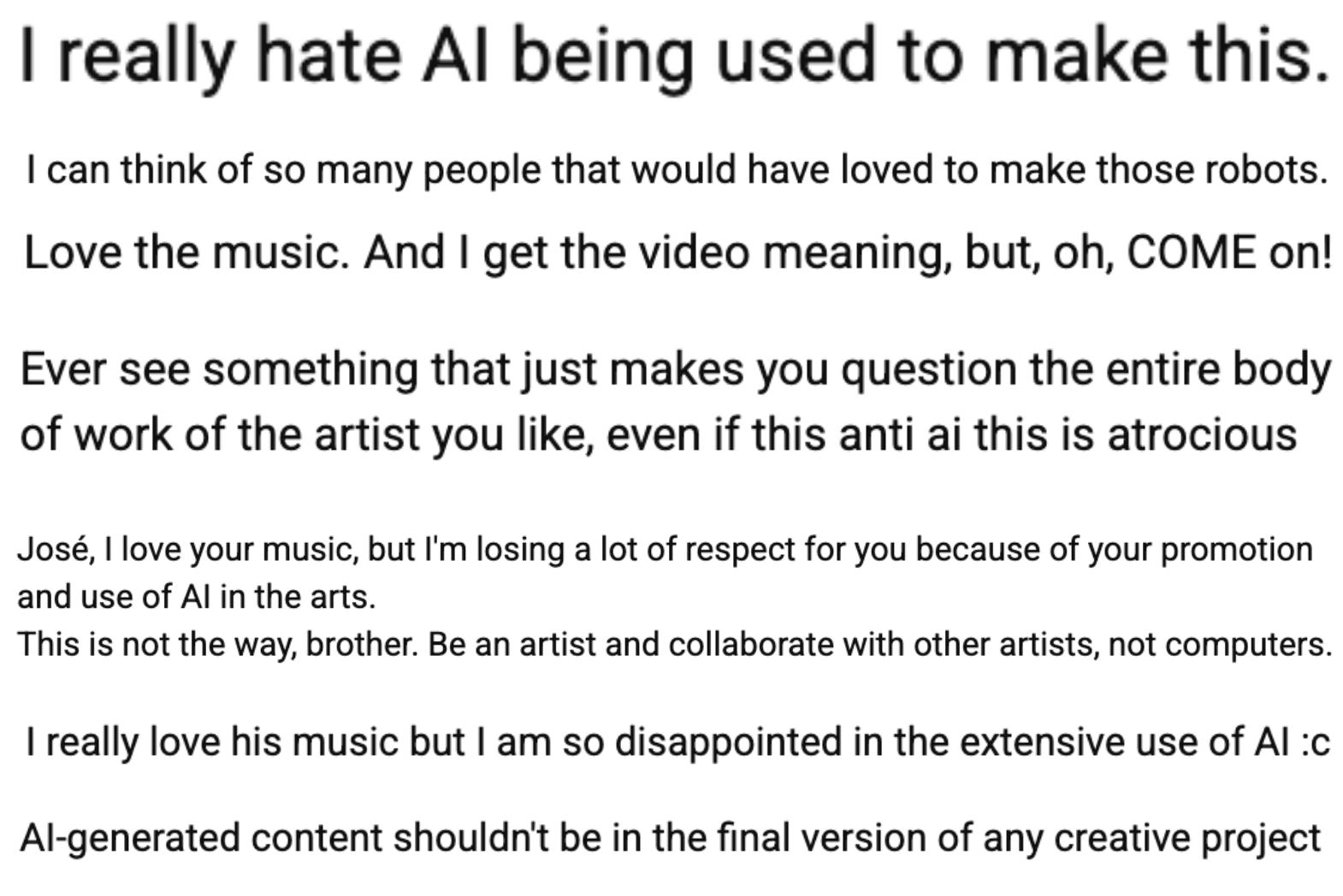
What’s depressing is that this music video actually employed tons of artists, but the inclusion of AI ruined the video for a lot of people, honestly, including me.
Obviously, this is just an anecdote and it’s not like everyone had a problem with the video, but nonetheless, it’s one that has confirmed a suspicion I had the moment AI was developed, and I started noticing people claiming that we need to use it to accelerate the spread of our messages:
Using AI to critique modernity, civilization, technology, and AI itself will most likely backfire.1
People do not like it, and I think a lot of really well-intentioned people underestimate how unpopular this technology really is. I really think we need to be paying attention to how much people fucking hate AI and everything it represents.
These commencement speeches have recently gone viral, where the speakers laud AI, only to be shocked when they are booed by the audience of young people who absolutely hate AI. A24 is currently experiencing backlash after their $75 million deal with Google’s DeepMind. Protests against data centers are exploding all over the world. Recently, The Atlantic reported millions of songs by all of our favorite artists have been used to train AI, without compensation, of course.
Right or wrong, misguided or naive, people hate AI.
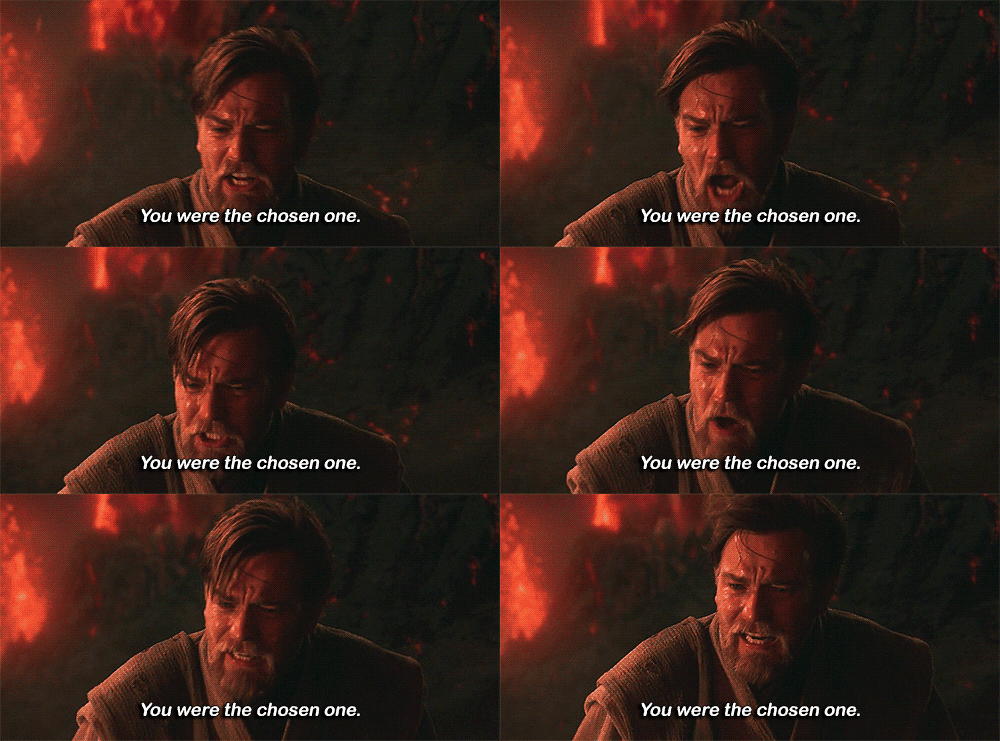
I am, proudly, one of those haters.
I recently made a video for my stupid little YouTube channel making my case for writers in particular to not use AI in their creative process. One of the points I made in regard to my own reasons for not using AI is that the message I am trying to share does not comport with AI usage on a philosophical level.
I said something to the effect of “my assumption is that my audience in particular would not approve of me using AI in my creative process.” This is because everything I create has a fundamentally skeptical approach to the promises of technology and civilization. Even if there are people in our audience who aren’t critical of AI, which there very much might be, I highly doubt they would respect us for long if we started writing scripts that sounded AI-generated, or using generative AI for animations, or if we had a chatbot write copy for social media posts, or, God forbid, help me write my novels.
Maybe I’m crazy, but I don’t think you, the audience, would very much like that!
And the reason I think that is because I don’t like it. As an artist myself, I deeply care about the process of how things are made. And while I certainly don’t represent everyone, I’m also not unique.
So when I, the very much intended audience for José Gonzaléz’s video, saw that AI was used in the video made specifically to critique technology, consumerism, modernity, etc, it left a sour enough taste in my mouth that I immediately started writing this essay.
And it’s not just because I don’t like AI and I think that the video would have been better if they paid a few extra artists to make the video, it’s because I think it is inherently hypocritical to use AI to critique AI, machines, modernity, or technology.
The typical response to an assertion like this is usually something like, “everything about modernity is unethical/destructive/toxic. It’s hypocritical to use the computer or the internet to critique these things, too, and yet you’re doing it right now.”

Funnily enough, this is also the exact response you receive if you dare to critique civilization and industrialism — while being functionally forced into living within it, I might add. Even when the speaker doesn’t intend it, it often functions as a way to shame people into shutting up.
Anyway, it’s easy to make the argument that using AI to spread our messages is the same as needing to use the internet, cars, or living within modern civilization at all in order to spread our messages. Given that the internet is one of the only modes available to anyone, not just me, to spread messages,2 for instance, that argument is usually just used to stop debate or deeper discourse into what we could call: the Machine Question.3
But why am I so certain that AI is different? Is it just that I’ve drawn an arbitrary line in the sand and I presume I am the most enlightened and therefore I know everything?
The difference for me — and this is key — it is a technology with an artificially inflated value that is a completely unnecessary addition to everything that is causing negative externalities within modernity. Industrial civilization and the internet and environmental destruction and extraction and a mechanistic worldview are all expanded with this technology that we don’t even need.4 And while it’s true that we can’t avoid participating in certain destructive aspects of civilization, it seems very strange to me that attempting to avoid or resist the most unnecessarily destructive technological developments has become suspect.
It’s giving psy-op.
And! All of its alleged benefits are essentially promissory. It might eventually solve climate change at some point, so we should probably feed it with all of the freshwater on Earth just in case. It’s so fucking stupid.
Anyway, not only does it accelerate every industrial process on Earth, when certain types of people (like myself) see it being used to create things and spread messages, they experience a feeling of carelessness on the part of the creator. They see someone unnecessarily using resources, stealing from the work of human beings, to create something that feels quick, dirty, and cheap. They feel disrespected. If you didn’t take the time to write this, why should I take the time to read it, watch it, listen to it, consume it?
People of all stripes don’t want to feel like piggies being fed slop.
It may seem innocuous to use an AI generated image for a thumbnail, or to use it to quickly clean up text before you send out a newsletter, but to the audience you’re trying to reach, you might be steadily eroding their trust in you. And when you have something genuinely important to say, I think this is a bad thing.
You’re subtly communicating to them (again, not everyone, but certain types of people) that you care more about optimization and production than you care about substance. And this might not actually be fair — you might be a creator who has only the best intentions in mind, but it’s like Kane Parsons said, something happens when we see generative AI: our brains shut off, and we stop caring about what is actually being communicated.
In the case of work that is trying to critique civilization, technology, or AI itself, I think it’s important that we remember what AI represents for the people we’re trying to reach. If our audience is full of people who feel like AI is eroding creative expression, stealing jobs, polluting the land, filling the coffers of the disgustingly rich, surveilling the masses, etc, etc, etc we cannot be surprised when those people do not want to engage with work that utilized AI, even in the smallest of ways. This rings especially hypocritical when critiquing these very systems. You may be alienating your potential audience making what, to you, seems to be a pretty benign decision.
This was the point I tried to make in my YouTube video. AI stains work it was used to create. It’s caustic. And when it’s actually unnecessary, I just don’t understand the point of turning people off of my work for the minor gains in efficiency (as if that’s what matters in the creation of art or educational content) it might offer me.
As people who have ambitions in both the art and the ecological/civilization-critical world, I think we have a valuable and possibly unique perspective to offer, and there’s some important reasons that AI has become something we can’t shut up about.
One thing I’ve been thinking about a lot is this idea that’s going around in the art world: people are acknowledging that when it comes to speed and efficiency of creation, the creators who use AI will win every single time. The consensus has become, from what I’ve seen, to not even try to compete with AI on that level. Let people who want to factory-produce AI content dominate the realm of quantity while the human creators dominate the realm of quality.
Even though it sucks right now and I don’t think it needed to go this way for people to remember to respect art and creation, I actually, strangely, think this will be good for the culture. It might actually make the cream rise to the top, or make modernity so horrendous that people start looking for a way out. Silver linings.
Anyway.
Culture, Jake and I have long surmised, is one of the most powerful planetary forces. A sick, broken, pathological culture (like the one we currently have) is literally changing the climate and exterminating species off the face of the Earth. If we agree that culture is a powerful force, then we have to interrogate how we contribute to culture, right?
If we contribute to the normalization of AI in art, we are contributing to the further mechanization of culture. This is bad. If we contribute to the normalization of AI in our ecological/civilization-critical/technology-skeptical works, we are also contributing to the further mechanization of culture… specifically in the realms that are trying to move back toward life. This might be worse than bad.
And what does the mechanization of culture do?
It leads to the further mechanization of life. It leads to more commodification.
It’s very easy to undervalue art and storytelling when we’re all looking at the world burning and we’re just trying to find a bucket of water. But the reality is, art and storytelling are at the center of culture. These two faculties of human existence impact every person every single day. It shapes how we understand ourselves and the world around us.5 Humans are constantly telling stories and engaging with art — it’s genuinely the glue that binds us together as a social creature. And as the quality of art erodes, and erodes exponentially with AI, so follows culture down the very path that we’re all trying to prevent it from going down.
So, no, I don’t think using AI in our creations is a benign decision. I think it signals to our audiences far more than we might think. It’s a choice that, whether we mean for it to or not, communicates that we’ll spread our messages at any cost, that we’ll concede to the machine if it means that our message gets out more quickly — that we will acquiesce to the machine to produce at the pace of all available technology.
Here’s the deal. None of us, and I mean none of us, will be able to beat the machine at its own game. It is absolute folly to try. But what we still have power over is our ideas, our ability to pay attention to the world around us, our experience of being embodied, alive, and real. Our suffering, our pain, our awe, and our ecstasy.
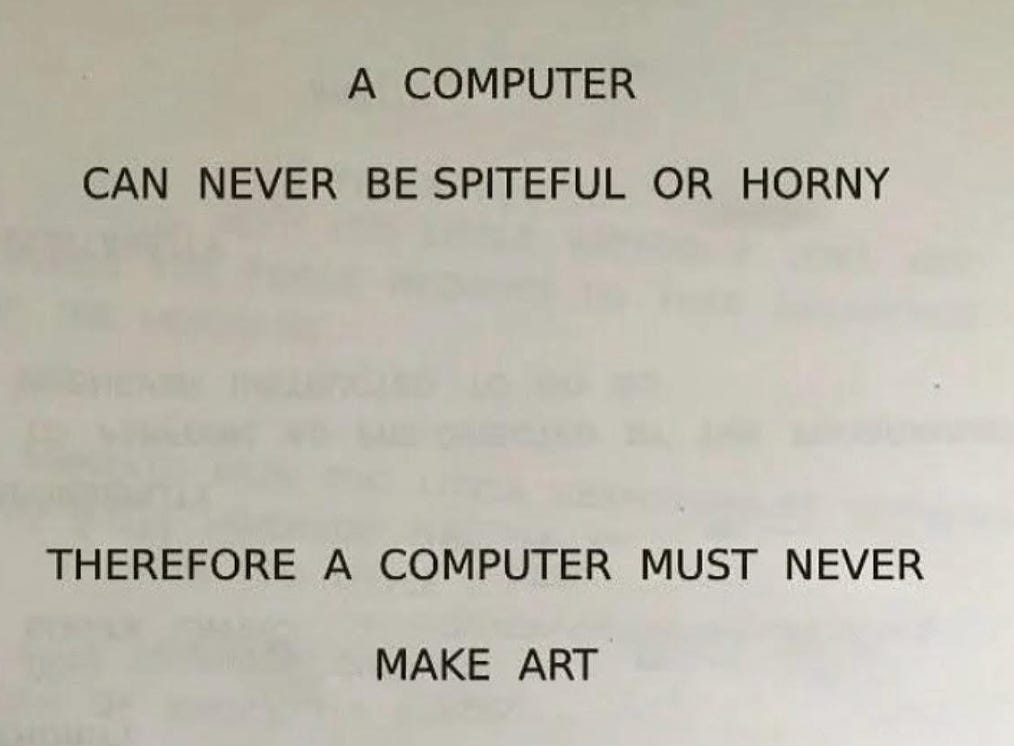
How we beat AI is by removing ourselves from its game. Produce things slowly and intentionally. Don’t take the bribe offered by AI: the shortcuts, the optimization, the polish. Produce things that no AI, nor anyone wielding AI, could ever conjure.
Honestly, why would we want to race to the average, to the lowest common denominator? That honestly feels so much more existential to me than the need to get our messages out quickly. In times like these, it’s our humanness, our imperfection, our realness that will carry us forward, differentiate us, and actually impact people on the level that we need.
If we let AI sand down our rough edges, polish our art, write our social media copy, animate our films, what are we really saying?
We’re saying that what makes us human is ineffectual and the machine, technology, industrialism — that’s what makes us better.
Is that not the exact opposite message many of us are trying to convey? Aren’t we trying to get people to see the beauty of nature and complexity of humanity? Aren’t we trying to push back against the enclosure of everything that makes life worth living?
I know it’s a common refrain right now that everything is so urgent that we can’t possibly slow down and take the time to actually create things — we have to use AI to reach people! — but every part of my embodied intuition tells me that if we keep trying to produce at the pace of AI, we’ll accelerate the destruction of the world far faster than we can imagine while completely delegitimizing ourselves and any message we want to share. We’ll inadvertently bury our very important messages.
My point here is this: if our messages matter to us, then the mode through which we create them should matter to us as well. We don’t have the power to control how they are shared in any significant way6 — but the creative process is something we do control.
Beyond the idea of the “medium is the message,” as Marshall McLuhan said, I think AI is calling us to see the process as the message. If we think of it this way, we genuinely need to ask ourselves: when I use this ‘tool’ to produce something, what is the actual message I’m spreading?
I’ll let you decide for yourself what it really communicates.
And look, maybe I’m wrong and I’m just a naive romantic. George Monbiot’s AI-generated film The Invisible Doctrine was a violent assault against my eyes, but a lot of people were able to get past it and just listen to the message. It has way more views than anything we’ve ever created, that’s for-damn-sure.
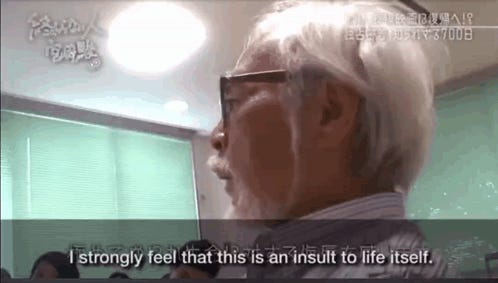
There may be plenty of people in your audience or mine that just care about the message. But there are entire cohorts of people that will feel disrespected by the lack of quality and intention. There are so many people who, like Hayao Miyazaki, see this as “insult to life itself.” And I think, as an artist trying to dip my toes into the world of ecology, civilization-analysis, and the rest of it, I ultimately want to treat my audience the way I want to be treated. I want my audience to trust that I don’t outsource my creativity just because I can. I want my audience to trust that I won’t take shortcuts, that I’ll labor for the message I’m trying to share. I want my audience to trust that I’m not just trying to make the cheapest, quickest content available to me — that them giving me their precious attention matters enough to me for me to do it all the way.
Maybe I’ll be left behind as every AI-enthusiast is wont to remind me.
Or maybe we all have an opportunity right now to model the kind of world we actually want to live in.
Written by Maren Morgan
Our new video on the Luddites and AI is out and currently at the mercy of the YouTube algorithm! It’s really hard to get creations in front of the right people in this day and age, especially when you have a small following and therefore have less algorithmic leverage, so it would really mean a lot to us if you would check out the video. We’re really not trying to be spammy — we just put a lot of work into this and think it’s good, so we want people to see it.
Generative AI was not used in any part of the creation of this video, and we plan to keep it that way for our future videos, books, everything. Thank you to our paid subscribers for helping make this video possible.
To be very, very clear, I don’t 100% blame, nor judge people, particularly my peers, for using AI. It may not seem like it in this essay, but I really do understand. It’s an extremely tantalizing technology. However, I do feel like I have a responsibility to share my perspective on this matter and not just pretend like it doesn’t have costs to the people using it, especially in the realm of creation where many of my interests intersect. I think this is a subject that needs to be debated and talked about far more than feels comfortable and I really struggle whether to share things that I’m really passionate about because my intention isn’t to make anyone feel bad. This is also not meant to be a call out of anyone in particular at all. Genuinely, I’m just trying to air my frustrations about a trend I’m seeing in a landscape that makes me feel like I’m going insane. I don’t want people’s art or essays or videos or anything that they’ve created to be considered to be slop because of AI usage. I know it has become a radical position to take, but I just want to encourage people to see that we don’t need this tech at all.
And that AI is not, in fact, a technology that resembles any other technology to ever exist.
I first read this phrase in Kirkpatrick Sale’s Rebels Against the Future where he’s using it in reference to technology and industrial society in general. Forcing the “Machine Question” is essentially visibilizing the harms that technology causes and placing those harms in a political arena. “This means laying out as clearly and fully as possible the costs and consequences of our technologies, in the near term and long, so that even those overwhelmed by the ease/comfort/speed/power of high-tech gadgetry (what Mumford called technical “bribery”) are forced to understand at what price it all comes and who pays for it.” Some of the subsequent questions he poses are: “Is this invention nothing but… an improved means to an unimproved end?” “Who are the winners, who the losers?” “Will this invention concentrate or disperse power, encourage or discourage self-worth?” “Can society at large afford it? Can the biosphere?” (p. 273)
Yes, yes, yes I know that AI is embedded in everything we use now, by force, I might add. Gotta keep the global economy alive, right?! Using this as a cudgel to stop debate is also dumb.
Random aside for people who might find this interesting. I stumbled open this post “Everyone is Wrong about AI Except Me” which shared a very interesting observation: for the past several decades, our media — our art — has been feeding us a steady stream of narratives that depict machines as being more human than us. Human bad and stupid, most of these films say, and then a robot comes along and solves the problem, or shows more empathy than the human counterparts. He writes, “Not only is the populace primed to treat artificial intelligence tools as living peers, they’ve been trained to hate or dismiss anyone who doesn’t. In the AI debate, I’m pretty sure nothing else matters...” Fascinating, and true. Even though I don’t interact with chatbots, I’ve been criticized for essentially dehumanizing them in my refusal to use them.
Which, to be clear, absolutely has its own implications and stains.
This is an interesting conversation, it's something that I myself have been contemplating and being present to. It seems to me that AI is much more appealing to the creators than it is to the consumers. Businesses love the idea of being able to "10x their production" but the consumers don't seem to benefit from it, in fact they often feel like they're being cheated in some way.
With that being said, from a creative point of view, I don't think it's as simple as people who use AI are lazy or taking short-cuts. Although most AI generated content is poorly made and generic, there are some exceptional use-cases that I've observed. Some of these AI workflows are very extensive and involve a lot of intention, direction and iteration and are also combined with video editing, sound design, etc. In fact, the best examples i've seen came from people with a lot of prior experience and skills in the creative realm.
I will say there is a psychological/perceptual phenomenon that I've observed within myself when observing content in general now, and that is that I'm uncomfortable with the blurring of what is real and not. I think it disrupts my sense of reality in a way that doesn't feel good.
At first, I was looking forward to being able to use AI to create things that I've only dreamed of having the budget to produce, but I've since dialed it back for a couple of reasons. First, my particular audience didn't seem too receptive to it. Second, I just felt the slipping away of my authentic voice. Often times ChatGPT wants to water down my message and make it more palatable, and sometimes I just want to deliver it how I want to.
Anyways, appreciate opening up the conversation and sharing your thoughts.
Take care.